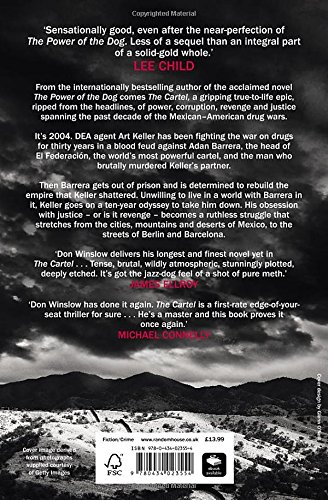
Don Winslow The Cartel livre pdf - The Cartel a été écrit par Don Winslow qui connu comme un auteur et ont écrit beaucoup de livres intéressants avec une grande narration. The Cartel a été l'un des livres de populer sur 2016. Il contient 640 pages et disponible sur format . Ce livre a été très surpris en raison de sa note rating et a obtenu environ avis des utilisateurs. Donc, après avoir terminé la lecture de ce livre, je recommande aux lecteurs de ne pas sous-estimer ce grand livre. Vous devez prendre The Cartel que votre liste de lecture ou vous serez regretter parce que vous ne l'avez pas lu encore dans votre vie.Rang parmi les ventes Amazon: #34533 dans LivresPublié le: 2015-06-25Langue d'origine: AnglaisNombre d'articles: 1Dimensions: 9.21" h x 1.26" l x 6.02" L, 1.76 livres Reliure: Broché640 pagesExtrait1 The BeekeepersWe think we can make honey without sharing in the fate of bees. —Muriel BarberyThe Elegance of the Hedgehog Abiquiú, New Mexico 2004 The bell rings an hour before dawn. The beekeeper, released from a nightmare, gets up. His small cell has a bed, a chair, and a desk. A single small window in the thick adobe wall looks out onto the gravel path, silver in the moonlight, which leads up toward the chapel. The desert morning is cold. The beekeeper pulls on a brown woolen shirt, khaki trousers, wool socks, and work shoes. Walking down the hall to the communal bathroom, he brushes his teeth, shaves with cold water, and then falls in with the line of monks walking to the chapel. No one speaks. Except for chanting, prayers, meetings, and necessary conversation at work, silence is the norm at the Monastery of Christ in the Desert. They live by Psalm 46:10—“Be still and know that I am God.” The beekeeper likes it that way. He’s heard enough words. Most of them were lies. Everyone in his former world, himself included, lied as a matter of course. If nothing else, you had to lie to yourself just to keep putting one foot in front of the other. You lied to other people to survive. Now he seeks truth in silence. He seeks God in the same, although he has come to believe that truth and God are the same. Truth, stillness, and God. When he first arrived, the monks didn’t ask him who he was or where he came from. They saw a man with saddened eyes, his hair still black but streaked with silver, his boxer’s shoulders a little stooped but still strong. He said that he was looking for quiet, and Brother Gregory, the abbot, responded that quietude was the one thing they had in abundance. The man paid for his small room in cash, and at first spent his days wandering the desert grounds, through the ocotillo and the sage, walking down to the Chama River or up onto the mountain slope. Eventually he found his way into the chapel and knelt in the back as the monks chanted their prayers. One day his route took him down to the apiary—close to the river because bees need water—and he watched Brother David work the hives. When Brother David needed help moving some frames, as a man approaching eighty did, the man pitched in. After that he went to work at the apiary every day, helping out and learning the craft, and when, months later, Brother David said it was finally time to retire, he suggested that Gregory give the job to the newcomer. “A layman?” Gregory asked. “He has a way with the bees,” David answered. The newcomer did his work quietly and well. He obeyed the rules, came to prayer, and was the best man with the bees they’d ever had. Under his care the hives produced excellent Grade A honey, which the monastery uses in its own brand of ale, or sells to tourists in eight-ounce jars, or peddles on the Internet. The beekeeper wanted nothing to do with the business aspects. Nor did he want to serve at table for the paying guests who came on retreats, or work in the kitchen or the gift shop. He just wanted to tend his hives. They left him alone to do that, and he’s been here for over four years. They don’t even know his name. He’s just “the beekeeper.” The Latino monks call him “El Colmenero.” They were surprised that on the first occasion when he spoke to them, it was in fluent Spanish. The monks talked about him, of course, in the brief times when they were allowed casual conversation. The beekeeper was a wanted man, a gangster, a bank robber. No, he’d fled an unhappy marriage, a scandal, a tragic affair. No, he was a spy. The last theory gained particular credence after the incident with the rabbit. The monastery had a large vegetable garden that the monks depended upon for their produce. Like most gardens, it was a lure for pests, but there was one particular rabbit that was wreaking absolute havoc. After a contentious meeting, Brother Gregory gave permission for—in fact, insisted upon—the rabbit’s execution. Brother Carlos was assigned the task and was standing outside the garden trying to handle both the CO2 pistol and his conscience—neither very successfully—as the other monks looked on. Carlos’s hand shook and his eyes filled with tears as he lifted the pistol and tried to pull the trigger. Just then El Colmenero walked by on his way up from the apiary. Without breaking stride, he took the pistol from Brother Carlos’s hand and, without seeming to aim or even look, fired. The pellet hit the rabbit in the brain, killing it instantly, and the beekeeper handed the pistol back and kept walking. After that, the speculation was that he had been a special agent, an 007. Brother Gregory put a stop to the gossip, which is, after all, a sin. “He’s a man seeking God,” the abbot said. “That’s all.” Now the beekeeper walks to the chapel for Vigils, which begin at 4:00 a.m. sharp. The chapel is simple adobe, its stone foundations hewn from the red rock cliffs that flank the southern edge of the monastery. The cross is wooden and sun-worn; inside, a single crucifix hangs over the altar. The beekeeper goes in and kneels. Catholicism was the religion of his youth. He was a daily communicant until he fell away. There seemed little point, he felt so far from God. Now he chants the Fiftieth Psalm along with the monks, in Latin: “O Lord, open up my lips, and my mouth shall proclaim your praise.” The chanting lulls him into a near trance, and he’s surprised, as always, when the hour is over and it’s time to go to the dining hall for breakfast, invariably oatmeal with dry wheat toast and tea. Then it’s back to prayer, Lauds, just as the sun is coming up over the mountains. He’s come to love this place, especially in the early morning, when the delicate light hits the adobe buildings and the sun sets the Chama River shimmering gold. He revels in those first rays of warmth, on the cactus taking shape out of the darkness, on the crunch of his feet on the gravel. There is simplicity here, and peace, and that’s all he really wants. Or needs. The days are the same in their routine: Vigils from 4:00 to 5:15, followed by breakfast. Then Lauds from 6:00 to 9:00, work from 9:00 to 12:40, then a quick, simple lunch. The monks work until Vespers at 5:50, have a light supper at 6:20, then Compline at 7:30. Then they go to bed. The beekeeper likes the discipline and the regimentation, the long hours of quiet work and the longer hours of prayer. Especially Vigils, because he loves the recitation of the Psalms. After Lauds, he walks down into the valley to the apiary. His bees—western honeybees, Apis mellifera—are coming out now in the early morning warmth. They’re immigrants—the species originated in North Africa and was transported to America via Spanish colonists back in the 1600s. Their lives are short—a worker bee might survive from a few weeks to a few months; a queen might reign for three to four years, although some have been known to live for as long as eight. The beekeeper has grown used to the attrition—a full 1 percent of his bees die every day, meaning that an entirely new population inhabits a colony every four months. It doesn’t matter. The colony is a superorganism, that is, an organism consisting of many organisms. The individual doesn’t matter. All that matters is the survival of the colony and the production of honey. The twenty Langstroth hives are built of red cedar with rectangular movable frames, as convenience dictates and the law demands. The beekeeper takes the outer cover from the honey-super of one of the hives and sees that it’s thick with wax, then carefully replaces it so as not to disturb the bees. He checks the water trough to make sure it’s fresh. Then he removes the lowest tray from one of the hives, takes out the Sig Sauer 9mm pistol, and checks the load. Metropolitan Correctional Center San Diego, California 2004 The prisoner’s day starts early. An automated horn wakes Adán Barrera at 6:00 a.m., and if he were in the general population instead of protective custody, he would go to the dining quad for breakfast at 6:15. Instead, the guards slip a tray with cold cereal and a plastic cup of weak orange juice through a slot in his door of his cell, a twelve-by-six-foot cage in the special housing unit on the top floor of the federal facility in downtown San Diego where for over a year Adán Barrera has spent twenty-three hours a day. The cell doesn’t have a window, but if it did he could see the brown hills of Tijuana, the city he once ruled like a prince. It’s that close, just across the border, a few miles by land, even closer across the water, and yet a universe away. Adán doesn’t mind not eating with the other prisoners—their conversation is idiotic and the threat is real. There are many people who want him dead—in Tijuana, all across Mexico, even in the States. Some for revenge, others from fear. Adán Barrera doesn’t look fearsome. Diminutive at five foot six, and slender, he still has a boyish face that matches his soft brown eyes. Far from a threat, he resembles more a victim who would be raped in ten seconds in the general population. Looking at him, it’s hard to credit that he has ordered hundreds of killings over his life, that he was a multibillionaire, more powerful than the presidents of many countries. Before his fall, Adán Barrera was “El Señor de los Cielos,” “the Lord of the Skies,” the most powerful drug patrón in the world, the man who had unified the Mexican cartels under his leadership, gave orders to thousands of men and women, influenced governments and economies. He owned mansions, ranches, private airplanes. Now he has the maximum-allowed $290 in a prison account from which he can draw to buy shaving cream, Coca-Cola, and ramen noodles. He has a blanket, two sheets, and a towel. Instead of his custom-tailored black suits, he wears an orange jumpsuit, a white T-shirt, and a ridiculous pair of black Crocs. He owns two pairs of white socks and two pairs of Jockey undershorts. He sits alone in a cage, eats garbage brought in on a tray, and waits for the show trial that will send him to another living hell for the rest of his life. Actually several lives, to be accurate, as he faces multiple life sentences under the “kingpin statutes.” The American prosecutors have tried to get him to “flip,” to become an informer, but he’s refused. An informer—a dedo, a soplón—is the lowest form of human life, a creature that does not deserve to live. Adán has his own code—he would rather die, or endure this living death, than become such an animal. He’s fifty—the best-case scenario, extremely doubtful, is that he gets thirty years. Even with “time served” he’ll be in his seventies before he walks out the door. More probably he’ll be carried out in a box. The slow trudge to trial drags on. After breakfast he cleans his cell for inspection at 7:30. By nature an almost obsessively orderly person, he keeps his space neat and clean anyway—one of his few comforts. At 8:00, the guards start the morning count of the prisoners, which takes about an hour. Then he’s free until 10:30, when they slip lunch—a bologna sandwich and some apple juice—through the door. He has “leisure time activities,” which for him means sitting and reading, or taking a nap, until 12:30, when they do another count. Then he has three and a half more hours of tedium until another count at 4:00. Dinner—“mystery meat” with potatoes or rice and some overcooked vegetables—is at 4:30, then he’s “free” until 9:15, when the guards count yet again. The lights are turned off at 10:30. For one hour a day—they vary the schedule for fear of snipers—guards lead him handcuffed out to a wired pen on the roof for fresh air and a “walk.” Every third day he’s taken for a ten-minute shower, sometimes tepid, more often cold. Occasionally he goes to a small meeting room to consult with his attorney. He’s sitting in his cell, filling out his order on the commissary form—a six-pack of bottled water, ramen noodles, oatmeal cookies—when the guard opens the door. “Attorney visit.” “I don’t think so,” Adán says. “I have nothing scheduled.” The guard shrugs—he does what he’s told to do. Adán leans and presses his hands against the wall as the guard shackles his ankles. An unnecessary humiliation, Adán thinks, but then again, that’s probably the point. They get into an elevator and ride down to the fourth floor, where the guard unlocks the door and lets him into a consultation room. He unshackles Adán’s ankles but chains him to the chair that’s bolted to the floor. Adán’s lawyer stands across the table. One look at Ben Tompkins and Adán knows something is wrong. “It’s Gloria,” Tompkins says. Adán knows what Tompkins is going to say before he says it. His daughter is dead. Gloria was born with cystic lymphangioma, a deformation of the head, face, and throat that is eventually fatal. And incurable—all Adán’s millions, all of his power, could not buy his daughter a normal life. A little over four years ago, Gloria’s health took a turn for the worse. With Adán’s blessing, his then wife, Lucía, an American citizen, took their twelve-year-old daughter to San Diego, to the Scripps clinics that housed the best specialists in the world. A month later Lucía phoned him at his safe house in Mexico. Come now, she said. They say she has days, maybe only hours ... Adán smuggled himself—like his own product—across the border, in the trunk of a specially outfitted car. Art Keller was waiting for him in the hospital parking lot. “My daughter,” Adán said. “She’s fine,” Keller said. Then the DEA agent jabbed a needle into Adán’s neck and the world went black. They were friends once, he and Art Keller. Hard to believe, but the truth often is. But that was another life, another world, really. That was back when Adán was (is it possible to have been that young?) twenty, an accounting student and wannabe boxing promoter (Dios mío, the foolish ambitions of youth) and not even thinking of joining his uncle in the pista secreta—the drug trade that flourished then in the poppy fields of their Sinaloan mountains. Then the Americans came, and with them Art Keller—idealistic, ener- getic, ambitious—a true believer in the war on drugs. He walked into the gym that Adán and his brother Raúl ran, sparred a few rounds, and they became friends. Adán introduced him to their uncle, then the top cop in Sinaloa and its second biggest gomero—opium grower. Keller, so naïve then, knew Tío’s first role and was blissfully ignorant (a notable trait of Americans, so dangerous to themselves and those within their flailing arms’ reach) of the latter. Tío used him. In all fairness, Adán has to admit that Tío made Keller his monigote, his puppet, manipulated him into taking out the top tier of the gomeros, clearing the way for Tío’s rise. Keller could never forgive that—the betrayal of his ideals. Take faith from the faithful, belief from the believer, and what do you have? The bitterest of enemies. For, más o menos, thirty years now. Thirty years of war, betrayals, killings. Thirty years of deaths— His uncle. His brother. Now his daughter. Gloria died in her sleep, her breath cut off by the weight of her heavy, misshapen head. Died without me there, Adán thinks. For which he blames Keller. The funeral will be in San Diego. “I’m going,” Adán says. “Adán . . .” “Make it happen.” Tompkins, aka “Minimum Ben,” goes to see federal attorney Bob Gibson, an ambitious ballbuster who prefers to be known as a “hard charger.” The sobriquet “Minimum Ben” reflects Tompkins’s success as a “drug lawyer”—his job isn’t to get his clients acquitted, because that usually isn’t going to happen. His job is to get them the shortest possible sentence, which is less about his skills as a lawyer than it is about his skills as a negotiator. “I’m sort of a reverse agent,” Tompkins once told a journalist. “I get my clients less than they deserve.” Now he relays Adán’s request to Gibson. “Out of the question,” Gibson says. Gibson’s nickname isn’t “Maximum Bob,” but he wishes it were and is a little envious of Tompkins. The defense attorney has a macho handle and makes a lot more money. Add to that the fact that Tompkins is a cool-looking dude with raffish silver hair, a surfer’s tan, a house on Del Mar beach, and an office that overlooks the ocean up in Cardiff, and it’s obvious why the civil servants in the prosecutor’s office hate Minimum Ben. “The man wants to bury his daughter, for Christ’s sake,” Tompkins says. “The man,” Gibson answers, “is the biggest drug kingpin in the world.” “Presumption of innocence,” Tompkins counters. “He’s been convicted of nothing.” “If I recall,” Gibson says, switching tack, “Barrera wasn’t too squeamish about killing other people’s kids.” Two of his rival’s small children, thrown off a bridge. “Old wives’ tales and unsubstantiated rumors,” Tompkins says, “passed around by his enemies. You can’t be serious.” “As a midnight phone call,” Gibson says. He refuses the request. Tompkins goes back and tells Adán, “I’ll take this in front of a judge and we’ll win. We’ll offer to pay for federal marshals, the cost of security . . .” “There isn’t time,” Adán says. “The funeral is on Sunday.” It’s already Friday afternoon. “I can get to a judge tonight,” Tompkins says. “Johnny Hoffman would issue an order—” “I can’t take the chance,” Adán says. “Tell them I’ll talk.” “What?” “If they let me attend Gloria’s funeral,” Adán says, “I’ll give them every- thing they want.” Tompkins blanches. He’s had clients snitch before for lighter sentences— in fact, it’s SOP—but the information they gave was always carefully pre-arranged with the cartels to minimize damage. This is a death sentence, a suicide pact. “Adán, don’t do this,” Tompkins begs. “We’ll win.” “Make the deal.” Fifty thousand red roses fill St. Joseph’s Cathedral in downtown San Diego just blocks from the Correctional Center. Adán ordered them through Tompkins, who arranged the funds through clean bank accounts in La Jolla. Thousands more flowers, in bouquets and wreaths—sent by all the major narcos in Mexico—line the steps outside. As do the DEA. Agents walk up and down past the floral arrangements and take notes on who sent what. They’re also tracking the hundreds of thousands of dollars in Gloria’s name contributed to a foundation for research into cystic lymph-angioma. The church is filled with flowers, but not mourners. If this were Mexico, Adán thinks, it would be overflowing, with hundreds of others waiting outside to show their respect. But most of Adán’s family is dead, and the others couldn’t cross the border without risking arrest. His sister, Elena, phoned to express her grief, her support, and her regret that a U.S. indictment prevented her from attending. Others—friends, business associates, and politicians on both sides of the border—didn’t want to be photographed by the DEA. Adán understands. So the mourners are mostly women—narco-wives who are American citizens already known to the DEA, but who have no reason to fear arrest. These women send their children to school in San Diego, come here to do their Christmas shopping, have spa days, or vacation at the beach resorts in La Jolla and Del Mar. Now they stride bravely up the steps of the cathedral and stare down the agents who take their photos. Dressed elegantly and expensively in black, most walk angrily past; a few stop, strike a pose, and make sure the agents spell their names correctly. The other mourners are Lucía’s family—her parents, her brothers and sisters, some cousins, and a few friends. Lucía looks drawn—grief-stricken, obviously—and frightened when she sees Adán. She betrayed him to Keller to keep herself out of jail, to keep Gloria from being taken by the state, and she knew that Adán would never have done anything to harm his daughter’s mother. But with Gloria gone, there’s nothing to stay his hand. Lucía could simply disappear one day and never be found. Now she glances anxiously at Adán and he turns his face away. Lucía is dead to him. Adán sits in the third row of pews, flanked by five U.S. marshals. He wears a black suit that Tompkins bought at Nordstrom’s, where Adán’s measurements are on file. His hands are cuffed in front of him, but at least they had the decency not to shackle him, so he kneels, stands, and sits as the service requires as the bishop’s words echo in the mostly empty cathedral. The Mass ends and Adán waits as the other mourners file out. He’s not allowed to speak to anyone except the marshals and his lawyer. Lucía glances at him again as she passes by, then quickly lowers her head, and Adán makes a mental note to have Tompkins get in touch with her to tell her that she’s in no danger. Let her live out her life, Adán thinks. As for financial support, she’s on her own. She can keep the La Jolla house, if the Treasury Department doesn’t find a way to take it from her, but that’s it. He’s not going to support a woman who betrayed him; who is, in effect, stupid enough to cut off her own lifeline. When the church clears, the marshals walk Adán out to a waiting limousine and put him in the backseat. The car follows Lucía’s behind the hearse out to El Camino Memorial Park in Sorrento Valley. Watching his daughter lowered into the earth, Adán lifts cuffed hands in prayer. The marshals are kind—they let him stoop down, scoop up a handful of dirt, and toss it on Gloria’s casket. It’s all over now. The only future is the past. To the man who has lost his only child, all that will be is what already was. Straightening up from his daughter’s grave, Adán says quietly to Tompkins, “Two million dollars. Cash.” To the man who kills Art Keller. Excerpted from The Cartel by Don Winslow. Copyright © 2015 by Samburu, Inc. Excerpted by permission of Knopf, a division of Random House LLC. All rights reserved. No part of this excerpt may be reproduced or reprinted without permission in writing from the publisher.Revue de presse"Don Winslow delivers his longest and finest novel yet in The Cartel. This is the War and Peace of dope-war books. Tense, brutal, wildly atmospheric, stunningly plotted, deeply etched. It’s got the jazz-dog feel of a shot of pure meth." (James Ellroy)"Sensationally good, even after the near-perfection of The Power of the Dog. Less of a sequel than an integral part of a solid-gold whole." (Lee Child)"The Cartel is a gut-punch of a novel. Big, ambitious, violent and widely entertaining, Don Winslow's latest is an absolute must-read." (Harlan Coben)"Don Winslow is one of the most exciting and well-researched crime writers of modern times. The Cartel is a masterpiece of storytelling." (Simon Kernick)"Astoundingly ambitious…Draws on real events and people as it chronicles Mexico’s drug wars…Masterfully organised and teeming with memorable characters, it is unlikely to be bettered this year." (Sunday Times (Thriller of the month))Présentation de l'éditeurFrom the internationally best-selling author of the acclaimed novel The Power of the Dog comes The Cartel, a gripping true-to-life epic, ripped from the headlines, of power, corruption, revenge and justice spanning the past decade of the Mexican-American drug wars.It’s 2004. DEA agent Art Keller has been fighting the war on drugs for thirty years in a blood feud against Adan Barrera, the head of El Federación, the world’s most powerful cartel, and the man who brutally murdered Keller’s partner. Finally putting Barrera away costs Keller dearly – the woman he loves, the beliefs he cherishes, the life he wants to lead.Then Barrera gets out, determined to rebuild the empire that Keller shattered. Unwilling to live in a world with Barrera in it, Keller goes on a ten-year odyssey to take him down. His obsession with justice – or is it revenge – becomes a ruthless struggle that stretches from the cities, mountains and deserts of Mexico, to Washington’s corridors of power, to the streets of Berlin and Barcelona.Keller fights his personal battle against the devastated backdrop of Mexico’s drug war, a conflict of unprecedented scale and viciousness, as cartels vie for power and he comes to the final reckoning with Barrera – and himself - that he always knew must happen.The Cartel is true-to-life story of power, corruption, revenge, honour and sacrifice, as one man tries to face down the devil without losing his soul. It is the story of the war on drugs and the men – and women – who wage it.